
In the high-stakes theater of Overwatch 2, most Support heroes are viewed through the lens of preservation—reactive agents who mend wounds. Lúcio Correia dos Santos, however, operates as the "Sonic Vanguard." He is the primary architect of a team’s momentum, a character whose utility is measured not just in health restored, but in the "tempo" of the engagement. In high-level competitive play, tempo is the lifeblood of victory; it is the ability to dictate when a fight begins, how quickly a team rotates through a choke point, and when to disengage before a disaster unfolds. By manipulating the speed of his allies, Lúcio transforms a standard squad into a coordinated strike force.
The core appeal of Lúcio lies in his unique mechanical duality. He possesses a remarkably low floor, allowing beginners to provide passive value simply by existing near their teammates, yet he boasts the highest skill ceiling in the game due to his complex movement physics. He is a hero of optimism and high-speed harassment, a support who can duel snipers in the backline while simultaneously keeping his frontline mobile. To truly understand the power of this musical revolutionary, however, we must look beyond the skates and into the grassroots struggle that birthed his legend.
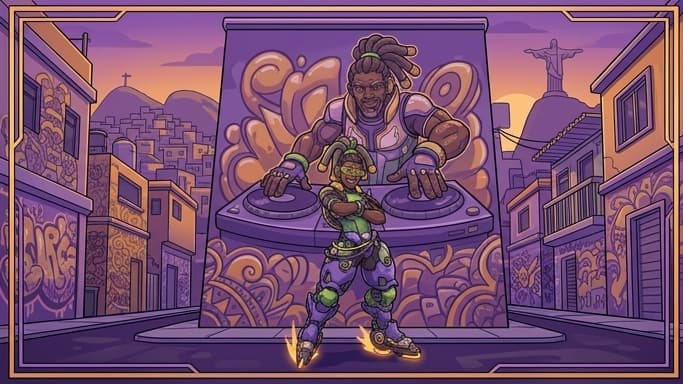
From the Favelas to Freedom: Deconstructing the Vishkar Conflict
Lúcio’s narrative is a poignant micro-study of grassroots resistance against corporate hegemony. His story begins in the crowded favelas of Rio de Janeiro, a region left fractured by the financial collapse following the Omnic Crisis. While the world looked to global entities for salvation, the Vishkar Corporation arrived with promises of "order" and "redevelopment." For Lúcio, this was an occupation. Vishkar’s version of order manifested as strict curfews, the suppression of local culture, and the exploitation of the populace as a cheap labor force.
The ethical weight of Lúcio’s kit is found in the origins of his technology. His Sonic Amplifier is often mislabeled as "stolen tech," but it is a reclaimed familial legacy. The sonic research Vishkar used to suppress the people of Rio was pioneered by Lúcio’s father, a brilliant independent scientist whom the corporation controlled and eventually ruined. His father’s original work on healing frequencies was twisted by Vishkar into tools of sonic suppression. By seizing this equipment, Lúcio "freed the heart" of his community through speed and "mended the community" through sound, transforming corporate tools into instruments of liberation. This transition from an underground street performer to a global icon and a member of the reformed Overwatch highlights his evolution from a local hero to a central figure in the fight against Null Sector.
The Battle for Rio: Local Activism vs. Corporate Order
| Vishkar Corporation’s Promises | The Reality Lúcio Fought |
|---|---|
| Urban Redevelopment: Creating "Hard-Light" cities for the displaced. | Sonic Suppression: Using co-opted research to silence the populace. |
| Social Order: Implementing structure to prevent "lawless behavior." | Labor Exploitation: Treating citizens as cheap, disposable resources. |
| Community Improvement: Promising a bright, technological future. | Loss of Liberty: Implementing curfews and stifling local expression. |

Designing the Bard: The Blueprint of a Cultural Icon
The design philosophy behind Lúcio was an ambitious attempt to translate the "Bard" archetype from traditional tabletop RPGs into a fast-paced first-person shooter. Blizzard’s goal was to create a music-based hero who could cast ability-boosting auras on their party while remaining highly mobile. This required a visual language that felt both heroic and grounded in the vibrant music culture of Brazil.
Arnold Tsang, the character's lead concept artist, steered Lúcio’s visual evolution through several iterations. Early designs featured stylized skull imagery, which was eventually abandoned in favor of the iconic "giant monkey frog." This mascot, found on his tank top and as a shoulder tattoo, was inspired by Amazonian species associated with healing rituals, positioning Lúcio as a "modern shaman" of the battlefield. For Overwatch 2, his design was further refined to improve cultural authenticity. His original "foam-loc" headpiece—a DJ mask in the vein of Daft Punk—was replaced with natural, textured dreadlocks incorporating "cybergoth" glowing elements. This shift from a persona-driven DJ mask to his authentic self, paired with voice actor Jonny Cruz’s motivational performance, defines Lúcio as a high-energy, relatable leader.
The Physics of Flow: Mastering Wall Ride Mechanics
Lúcio’s "Wall Ride" passive is the most distinct movement mechanic in Overwatch, turning the environment into a 3D playground. Mastering this traversal system separates a standard support from a true Sonic Vanguard. The physics are governed by a momentum engine that rewards frame-perfect inputs and environmental awareness.
To achieve pro-level movement, you must first navigate to your settings and turn Wall Jump on Release: OFF. This is the secret to high-level control; it prevents the game from auto-jumping, allowing you to use the "One-Tick" and "Late Skim" mechanics that are essential for unpredictable movement.
- Momentum Preservation (Bunny Hopping): By jumping within a 0.45s window of hitting the ground, Lúcio preserves his horizontal velocity.
- Wall Skimming: Attaching and detaching from a wall within a 0.20s to 0.45s window allows you to "carry" the 50% speed boost from "Amp It Up" long after the cooldown begins.
- Late Jumping & Late Skimming: By launching off a surface at its very edge (the "Late Skim"), you gain a 30% speed boost. This allows you to effectively jump off thin air to clear massive gaps.
- One-Tick: Latching onto a wall and letting go without jumping. This is vital for fine-tuning your height when a full jump would put you in a sniper's line of sight.
- The Scroll Wheel Trick: High-level PC players bind "Jump" to the mouse scroll wheel. This allows for rapid, spammed inputs that make skimming off thin objects like trees or climbing corners with the 0.67s re-grip timer much more consistent.
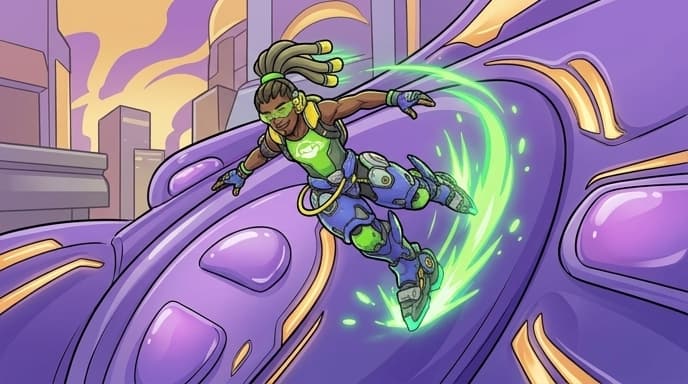
Pro-Tip: Console Optimization
Remapping "Jump" to a trigger (L1 on PlayStation or LB on Xbox) is non-negotiable for console players. This allows you to jump and wall-ride while keeping your thumb on the right analog stick, enabling you to aim your 22-damage sonic bursts and time your 8-meter Soundwaves simultaneously.
The Art of the Crossfade: Strategic Aura Management
Lúcio is a "force multiplier" for slower, brawlier heroes like Reinhardt or Junker Queen (a synergy famously known as JOATS). However, analysts warn against the "Heal-Bot" trap—staying on the healing aura to inflate stats. While the healing aura provides sustain, the Speed Aura is the tool used for kiting enemy ultimates and securing kills.
Strategic Phases of the Aura
- The Poke Phase: Priority is on healing and building "Sound Barrier." If you’ve selected the Noise Violation perk, your 150% increased radius allows you to provide utility even to spread-out "Poke" compositions.
- The Clash Phase: When engaging, switch to Speed and use "Amp It Up." This 50% speed bonus (and +50% attack speed if Accelerando is active) allows your team to overwhelm the enemy.
- The Retreat: If a fight is lost, use Speed and Soundwave (the "Boop") to peel. With an 8-meter range, a well-timed boop can disrupt a Junker Queen's axe or a Winston's dive.
Mastering Sound Barrier is about timing the "drop." Providing 750 decaying overhealth, it is the ultimate reactive defense. Dropping it mid-air can lead to a "wasted" beat; use your movement to find the fastest floor contact to neutralize burst-damage ultimates instantly.
The 2025 Evolution: Perks, Metas, and the Juno Rivalry
Lúcio’s longevity is legendary, evolving through the "Triple-Tank" and "GOATS" eras to the modern 2025 Perk System. This system uses Role Delta Tech to ensure fair matchups while allowing Lúcio to specialize his utility mid-match.
- Accelerando (Major): Provides a +50% attack speed buff during "Amp It Up," transforming Lúcio into a potent backline duelist.
- Noise Violation (Major): Increases Crossfade radius by 150% during "Amp," vital for supporting split teams.
- Radio Edit (Major): Generates 20 overhealth per second during "Amp," perfect for aggressive brawls.
- Bass Blowout (Minor): Increases Soundwave knockback distance—a necessity for environmental kills on maps like Ilios.
- Beat Boxing (Minor): Adds a +75% melee damage bonus after a Soundwave hit, ideal for finishing off low-health targets.
The year 2025 also introduced Juno. While Juno offers a significant burst of speed via her Hyper Ring, she lacks Lúcio’s on-demand, mobile aura. Critically, Juno has no self-heal and no crowd control (Boop), making Lúcio the superior "stat-check" against flankers like Tracer or Sombra. Lúcio’s ability to exist in the "0.67s re-grip" window of a wall makes him a survivor in a way Juno cannot replicate.
Dropping the Beat: The Legacy of a Freedom Fighter
Lúcio’s impact transcends the scoreboard; he is a symbol of optimism and the power of individual action against systemic oppression. He represents a future where technology is reclaimed by the people to build community rather than enforce order. This cultural weight is reflected in real-world artifacts like the Synaesthesia Auditiva album—featuring tracks like "Rejuvenescência"—and the "Lúcio-Oh’s" cereal.
Lúcio reminds us that the best way to move forward is together. For those picking up the Sonic Amplifier, remember: the wall is your playground and the rhythm is your weapon. Master your settings, respect the physics of the 0.45s hop, and find your rhythm. It’s time to drop the beat.